
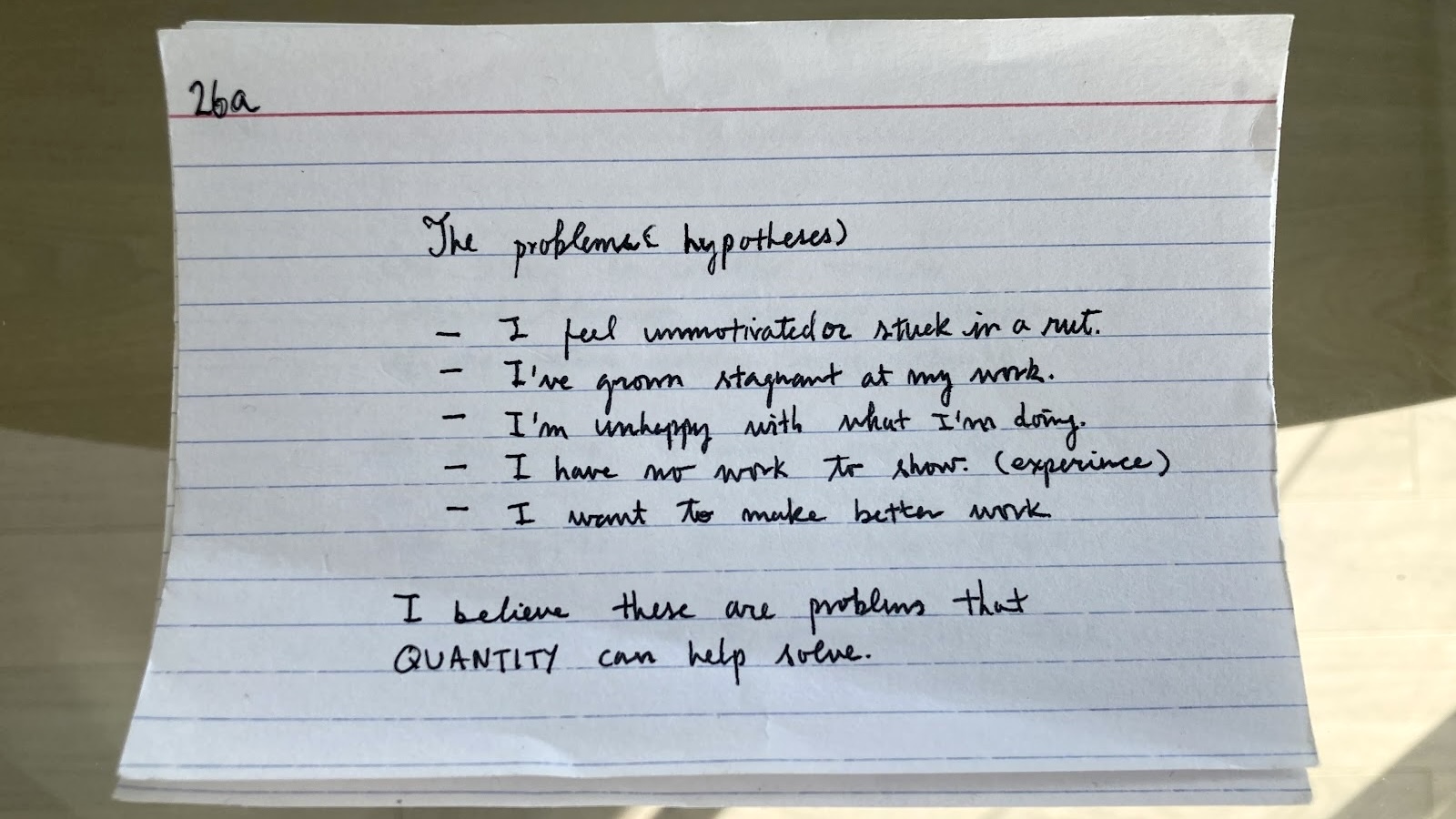
A Zettelkasten is a box of small notes that talk to each other.
Each note contains one single idea.
Notes are linked to other notes that are related.
Over time, the notes form a thinking network, not a folder tree.
You don’t store topics.
You store thoughts.
Basic rules
- One note = one idea
- Write in your own words
- Link notes that belong together
- Let structure grow naturally
That’s it.
Example 1: Your first note
Imagine you read something and think.
“Writing helps me think more clearly.”
You make one note.
Note A
Writing clarifies thinking.
When I write, vague thoughts become more precise.
That’s a complete note. Nothing more.
Example 2: Another note, linked
Later you notice something related.
“Talking doesn’t help me think as well as writing.”
You make a second note:
Note B
Writing slows thinking down in a useful way.
Speaking happens too fast to notice gaps in reasoning.
Now you link them:
- Note A → Note B
- Note B → Note A
The notes now support each other.
Example 3: A note from experience (not theory)
You notice something while working.
Note C
When I try to solve a problem in my head, I get stuck.
When I write it down step by step, solutions appear.
You link it to Note A:
- Writing clarifies thinking → proven by experience
Now you have a small cluster about writing and thinking.
What a Zettelkasten is
- ✅ Your own thoughts
- ✅ Small and focused
- ✅ Connected
What a Zettelkasten is NOT
- ❌ Not a summary of a book
- ❌ Not a list of quotes
- ❌ Not folders like “Psychology / Writing / Ideas”
Why people use it
- It helps you think better
- Ideas don’t get lost
- Writing becomes easier because:
- You’re never starting from nothing
- You’re always continuing a thought
Summary
A Zettelkasten is a growing web of small, linked ideas written in your own words, built to help you think, not just store information.
Resources
”Zettelkasten — How One German Scholar Was So Freakishly Productive”
David B. Clear’s article on Luhmann’s story.
Luhmann’s original essay ”Communicating with Slip Boxes”
Short, accessible, and provides insight directly from the source. Surprisingly easy to read.
https://luhmann.surge.sh/communicating-with-slip-boxes
Sönke Ahrens – ”How to Take Smart Notes”
The standard work. Explains the thinking behind the method, not just the mechanics. Available as book and e-book.
https://www.soenkeahrens.de/en/takesmartnotes
The-Archive-Demo-Notes (GitHub)
A concrete example of what a Zettelkasten actually looks like in practice. Great for those who learn by seeing rather than reading about.
https://github.com/Zettelkasten-Method/The-Archive-Demo-Notes
Lämna ett svar